

The architectural jewel of Santa Sofia
A masterpiece of Lombard art
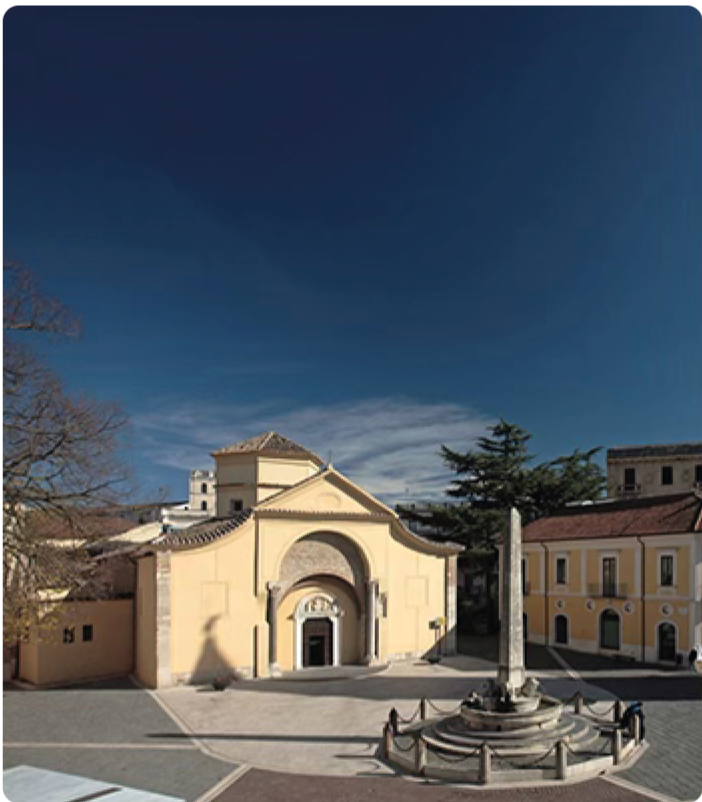
The Church of Santa Sofia in Benevento is one of the most extraordinary examples of Lombard religious architecture and represents a unicum in the panorama of medieval European art.
Built between 758 and 760 AD at the behest of Duke Arechi II, the church is now recognized as a UNESCO World Heritage Site, falling within the serial site The Lombards in Italy. Places of Power (568-774 AD).
Arechi II, duke of Benevento and great strategist, was fully aware of the political and cultural importance of his duchy. After the fall of the Lombard kingdom in northern Italy in 774 at the hands of Charlemagne, Benevento became the main bastion of Lombard identity in the peninsula.
In this context, the Church of Santa Sofia was conceived as a national temple and votive chapel of the Lombard people, representing at the highest level the ideology of Lombard power.
Its dedication to St. Sophia (Sancta Sapientia, the Holy Wisdom) may have been inspired by the great basilica of Hagia Sophia in Constantinople, present-day Istanbul, an imperial symbol of strength and spirituality.
Benevento: crossroads of cultures and strategies
Benevento’s exceptional geographical location, situated between the Tyrrhenian and Ionian sides, has always favored human settlement and the flourishing of cultures. The Duchy has its roots well before the Lombard invasion of 568.
As early as the 6th century, Lombard mercenaries, known as foederati, fought alongside the Byzantines in the Greco-Gothic War (535-552), finding refuge in various areas of the Apennines. When new Lombard groups invaded the peninsula, they joined their existing countrymen, consolidating an increasingly entrenched Germanic presence in southern Italy.
Benevento thus became a strategic center of the gens Langobardorum. The Lombard city developed over a smaller area than Roman Benevento, but with a more fortified urban layout. After the devastation inflicted by the Ostrogothic king Totila in 545 AD, the pre-existing walls were renovated and strengthened.
In the 8th century the city experienced a strong building impulse at the hands of Arechi II who, especially after the collapse of the Lombard kingdom in northern Italy, aware of the importance assumed by the Duchy of Benevento, became the promoter of notable works aimed at exalting in monumental forms the capital of the Duchy. Prominent among these is the Church of St. Sophia, the symbol of this renewal.
A unique and revolutionary architecture
Santa Sofia is an unprecedented building: it is the most important and original Longobard-era religious building in Italy, unique in its floor plan.
Its original structure stems from the fusion of the Roman-Hellenistic architectural tradition, the Byzantine influences of the centrally planned churches of the 5th and 6th centuries, and the innovative experimental spirit of the Lombards, also evident in the skillful reuse of ancient materials (spolia). The church anticipates the renewed interest in centrally planned buildings that would spread across northern Europe in the Carolingian era, especially for palace chapels.
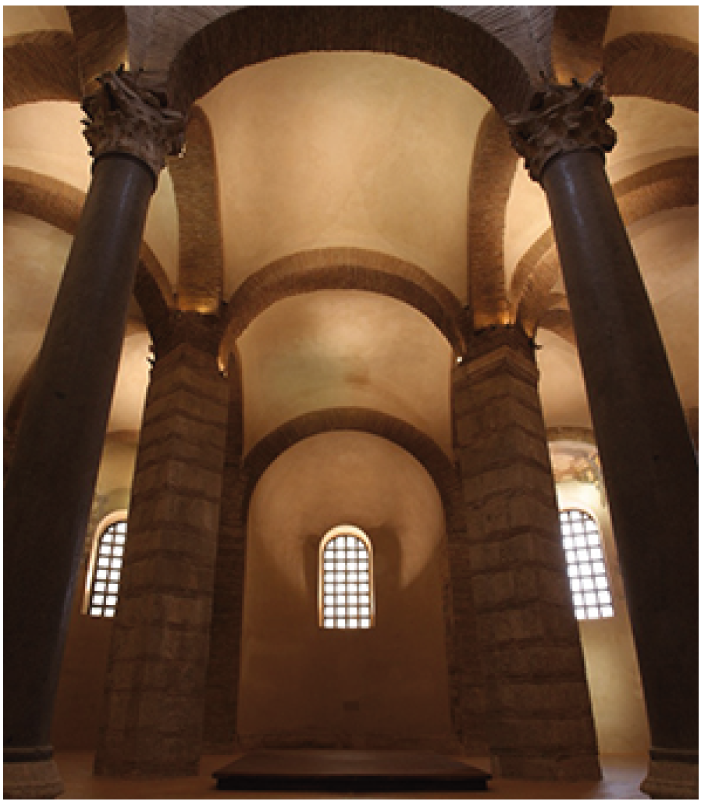
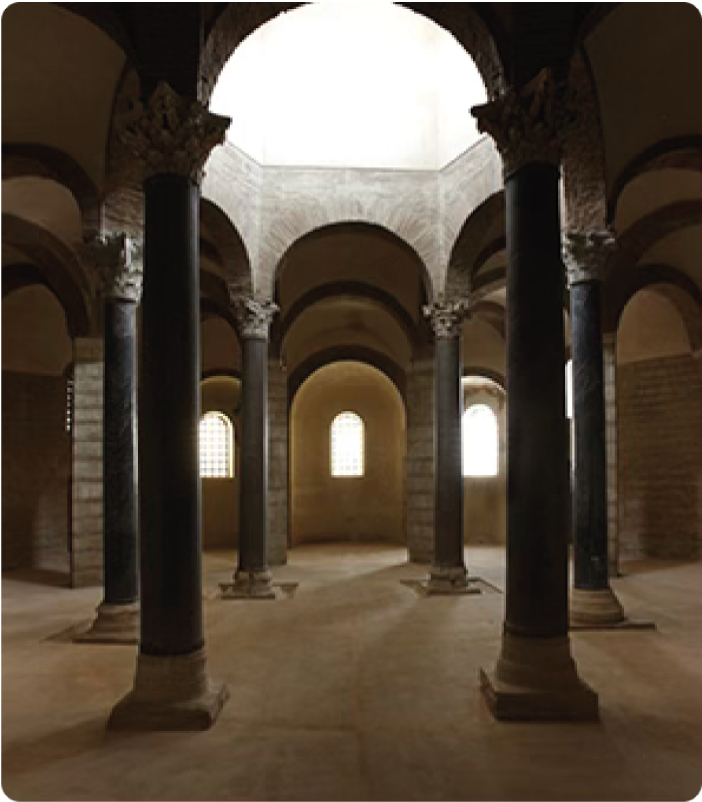
The church, small in size (23.50 meters in diameter), presents an interesting architecture with a unique star plan, converging from the entrance to the three apses. This solution, rare in the Lombard period, reinterprets the central plan of probable Byzantine influence with a spatial dynamism that changes according to the viewpoints.
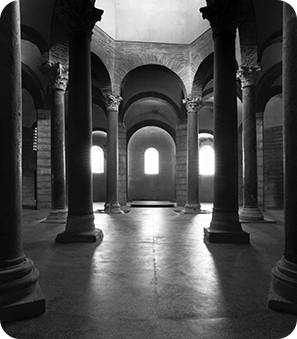
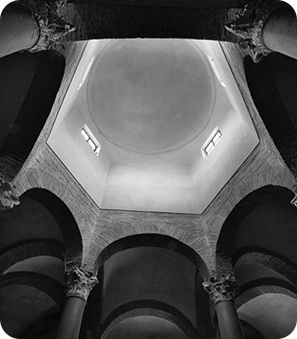
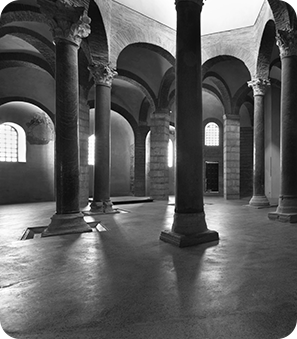
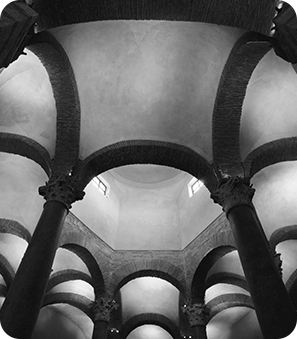
The building has two concentric ambulacra: the first, more internal, defined by six columns forming a regular hexagon, supported the original dome, which was lower than the one rebuilt after the 1688 earthquake. The outer ambulatory, on the other hand, has a decagonal shape and is marked by quadrangular pillars, arranged in such a way as to follow the directional variations of the perimeter walls, creating privileged axes for reading the entire structure.
The columns of the hexagon reuse capitals from the classical period and, as bases, inverted ancient capitals also modified with the addition of decorative motifs.
The pillars and the two columns of the decagon, made of alternating stone and brick blocks, are surmounted by early medieval pulvinos decorated with motifs similar to those of Lombard goldsmithing and the carved altars of Ratchis and Callisto in Cividale, highlighting the cultural continuity between Langobardia Maior and Minor.
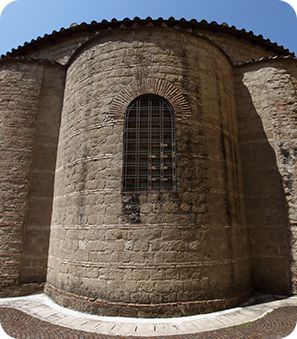
The numerous ancient perusal materials found in St. Sophia are reused in a decidedly structural and not merely decorative function, testifying to the respect and concrete consideration in which such relics of the past were held and the significant role reserved for them.
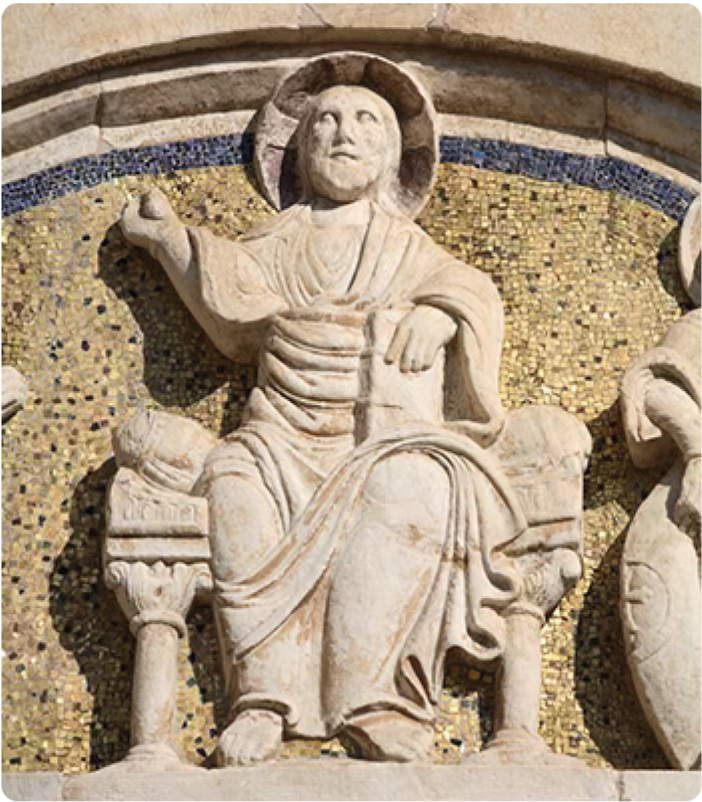
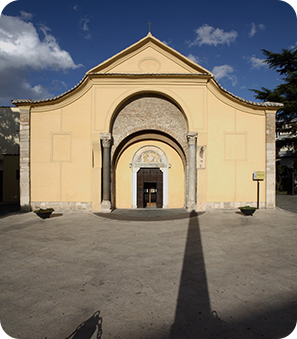
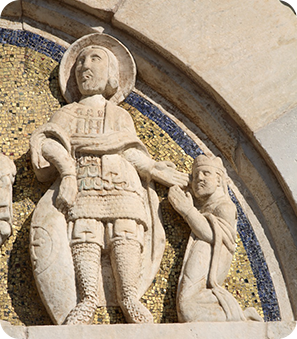
The facade, in Baroque style, reflects the appearance given to the building after the 1688 earthquake. In the center is the entrance, part of a structure added in the 12th century, with an elegant marble portal decorated with high relief sculptures on a gilded background. The tympanum is connected at the sides with slight curves.
Next to the main portal, traces of an ancient pictorial decoration are preserved, consisting of overlapping semicircular colored leaves. This motif, rare in the Middle Ages, recalls decorative patterns from Roman times and may indicate that the Lombard church had a painted exterior or a frescoed portico.
Lombard frescoes: a fragile but precious heritage
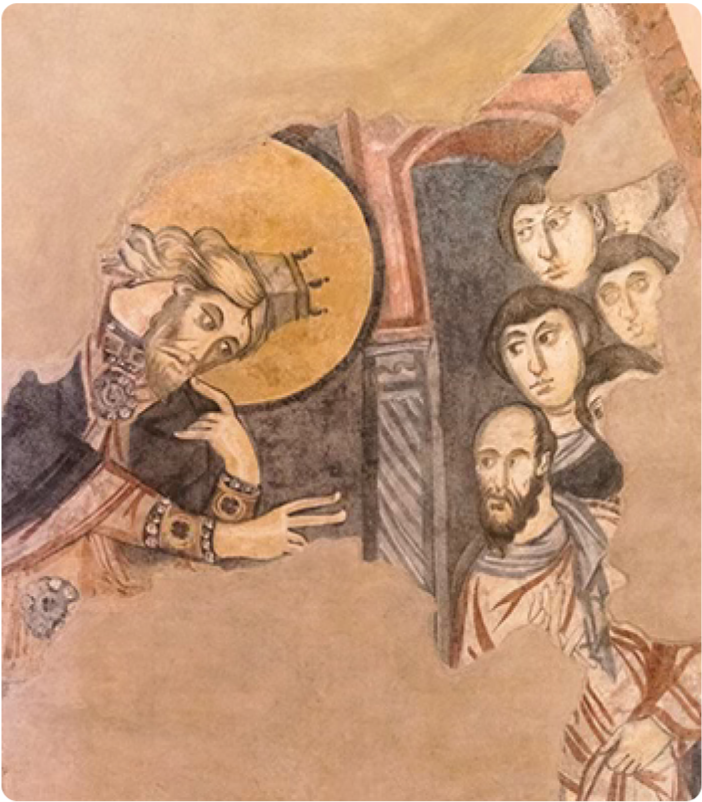
The interior of the church was originally entirely frescoed, but only a few pictorial fragments have been preserved.
The apses present scenes from the life of Christ from the Gospel of Luke, including the Announcement to Zechariah and the Visitation. These frescos, among the most important examples of Lombard painting, show Hellenistic and Syro-Palestinian artistic influences, suggesting the circulation of craftsmen and visual models between the East and Italy.
These paintings, although fragmentary, represent an important testimony to Lombard artistic sensibility, highlighting the attempt to reconcile classical tradition with the new Christian spirituality.
The monastery and the Romanesque cloister
Next to the church, Arechi II wanted the construction of a women’s monastery, entrusting it to his sister Gariperga. This coenoby was to ensure the presence of a religious community that would strengthen the link between ducal power and the sacred sphere.
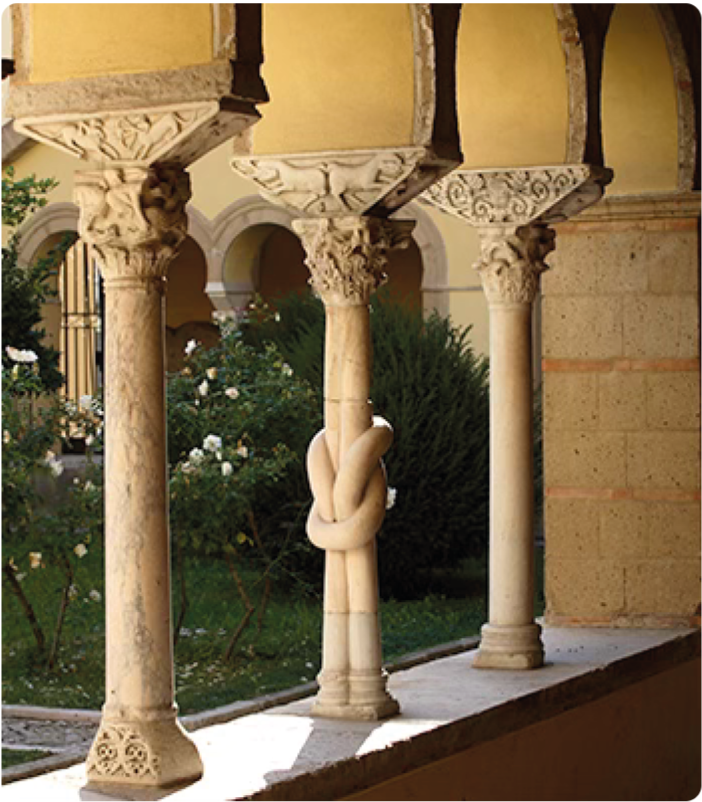
Of the ancient monastic complex today remains the striking cloister, rebuilt in the Romanesque period between 1159 and 1182.
With its elegant columns and decorated capitals, the cloister is a fine example of medieval architecture and is now home to the Sannio Museum, which preserves valuable artifacts related to Lombard and Samnite history.
A symbol of Lombard grandeur
The Church of Santa Sofia is not only an architectural masterpiece, but a manifesto of Lombard greatness. It expresses Arechi II’s desire to leave an indelible mark on the cultural landscape of the time, creating a building that combined innovation, power and spirituality.
Today, this extraordinary monument continues to tell the story of a people and its refined artistic sense, remaining one of the most precious testimonies of Lombard civilization in Italy.